A burst pipe is one of the most stressful plumbing emergencies a homeowner can face. Whether it happens in the middle of a cold winter night or on a sweltering Austin afternoon when thermal expansion takes its toll on aging copper lines, the first 15 minutes after a pipe bursts are the most critical. The actions you take or fail to take in those moments directly determine how much structural damage, mold growth, and repair cost your home will endure.
At Allstate Plumbing Heat & Air, we’ve responded to hundreds of burst pipe emergencies across Austin, Lake Travis, Lakeway, and surrounding communities. In this guide, our licensed plumbers walk you through exactly what to do step by step from the moment you discover a burst pipe until our team arrives at your door.
In This Article
- Why Pipes Burst (Especially in Austin & Lake Travis)
- Step 1 – Shut Off the Main Water Supply Immediately
- Step 2 – Turn Off the Electricity in Affected Areas
- Step 3 – Open Faucets to Drain Remaining Water
- Step 4 – Locate and Identify the Burst
- Step 5 – Begin Water Removal & Containment
- Step 6 – Document Everything for Insurance
- Step 7 – Apply a Temporary Patch (If Safe)
- When to Call a Water Damage Restoration Company
- Frequently Asked Questions
Why Pipes Burst Especially in Austin & Lake Travis
Many homeowners assume burst pipes only happen in northern, freeze-prone states. But Central Texas properties are actually particularly vulnerable for a surprising mix of reasons:
- Sudden temperature drops: Austin and Lake Travis experience periodic hard freezes (as seen in recent February events) that catch pipes especially in uninsulated garages, attics, and exterior walls completely off guard. Pipes freeze and then burst when the ice expands inside the pipe wall.
- Thermal expansion in summer heat: The opposite is also true. During triple-digit Texas summers, unprotected exterior pipes and even indoor pipes near poorly insulated walls experience significant thermal stress, leading to micro-fractures that eventually give way.
- Aging infrastructure: Many homes in Austin’s established neighborhoods Hyde Park, East Austin, South Congress, and the Lake Travis lakefront communities still run on original copper or galvanized steel lines that are decades old and increasingly fragile.
- Hard water corrosion: Lake Travis area water is notoriously hard. Mineral buildup inside pipe walls reduces their thickness over time, making them far more susceptible to pressure surges.
- Tree root intrusion: Austin’s lush mature canopy is beautiful, but oak and cedar root systems aggressively seek moisture, eventually cracking underground water lines.
Act Fast Time Is Money
A burst pipe can release up to 100 gallons of water per hour. In just 30 minutes, that’s enough to saturate drywall, buckle wood flooring, and create the warm, damp conditions mold needs to begin colonizing often within 24 to 48 hours.
The 7 Emergency Steps to Take Right Now
Shut Off the Main Water Supply Immediately
This is the single most important action you can take. Every second the water runs, more damage occurs. Locate your main shut-off valve in most Austin-area homes it’s either near the street at the meter box, or inside the home near the water heater or utility room and turn it fully clockwise (righty-tighty) until it stops. If it’s a lever-style valve, rotate it 90° so it runs perpendicular to the pipe.
Pro tip: Before a pipe ever bursts, walk your property with every household member and locate this valve. In an emergency, you shouldn’t be searching for it.
Turn Off Electricity in Affected Areas
Water and electricity are a lethal combination. If the burst pipe is near an electrical panel, outlets, or light fixtures or if water is pooling near any electrical source go to your breaker box and switch off the circuits for those rooms. Do not enter standing water in any room until you have confirmed the power is off. If you cannot safely reach the breaker panel, call your utility provider (Austin Energy: 512-322-9100) to shut off power from outside.
Open Faucets to Drain Remaining Pressure
Once the main supply is shut off, open all cold-water faucets throughout the house both indoors and outside. This relieves the residual water pressure still in your pipes and drains the remaining water away from the burst location, reducing the total volume of water that will continue to leak. Leave faucets open until the flow reduces to a drip. Do not open hot-water taps at this stage, as this can draw air into the water heater and cause damage to the heating element.
Locate and Identify the Burst Pipe
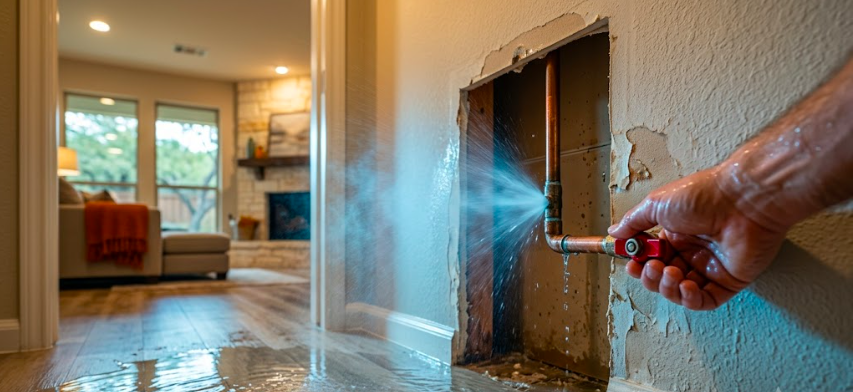
Once water flow has slowed, try to find where the pipe actually burst. Signs include: water spraying or dripping from a visible pipe, a bulge or wet stain on a wall or ceiling, wet insulation in an attic or crawlspace, or the sound of rushing water behind a wall even after the main is off. Mark the location with tape or a sticky note so our plumbers can go straight to it when they arrive. Take a photo or video while the leak is active this is crucial for insurance purposes.
Begin Water Removal & Containment
Every ounce of water you remove in the next hour is water that won’t seep into subfloors, wall cavities, or insulation. Use mops, wet/dry shop vacs, towels, and buckets to clear standing water from hard floors. Roll up and remove wet area rugs these hold moisture and encourage mold. Place aluminum foil under furniture legs to prevent wood staining on wet carpet. Open windows and run ceiling fans to begin air circulation and evaporation. If you own or can borrow a dehumidifier, deploy it immediately.
Document Everything for Insurance
Before cleaning up more than necessary to prevent further damage, photograph and video record everything: the burst pipe, all water-affected flooring, walls, ceilings, furniture, and personal belongings. Note the date and time. Write a brief timeline of events. Your homeowners insurance claim will go far more smoothly and result in a better payout when you have clear visual evidence taken in real time. Store these photos in cloud storage immediately so they are not lost if a device is damaged.
Apply a Temporary Patch (If Safe and Accessible)
If the burst is on a visible, accessible pipe and water flow has stopped after the main shutoff, a temporary repair can buy you time and prevent additional drips from residual water. Use pipe repair tape (self-fusing silicone tape) wrapped tightly around the damaged section, overlapping by at least half an inch on each side of the break. A pipe clamp kit from a hardware store is even more effective.
Important: This is a temporary measure only it does not replace professional pipe repair. Never use duct tape or plastic wrap on a pipe under pressure.
When the Pipe is Fixed But the Damage Isn’t Over
One of the most important things homeowners overlook after a burst pipe is what happens after the plumber leaves. Fixing the broken pipe stops the source of water but it does nothing for the water that already saturated your walls, subfloors, insulation, and structural framing. This is where many homeowners make a costly mistake: they assume the damage is done, dry out visible surfaces with fans, and move on.
In reality, water that penetrates behind drywall, under flooring, and into wall cavities can remain trapped for weeks creating exactly the warm, humid conditions that mold, mildew, and structural rot need to develop. In Central Texas’s climate, mold can begin forming in as little as 24–48 hours in compromised areas you can’t even see.
Don’t Overlook Hidden Water Damage
Professional water damage restoration uses industrial moisture meters, thermal imaging cameras, and commercial-grade dehumidifiers to detect and eliminate moisture that your eyes and household fans simply cannot reach. If your home experienced significant flooding from a burst pipe, professional restoration is not optional; it is essential.
Need Professional Water Damage Restoration?
If you’re dealing with water damage beyond what standard plumbing repair covers, the team at Akron OH Water Damage specializes in full-service water damage restoration including moisture extraction, structural drying, mold remediation, and insurance claim support. Getting professional restoration done quickly is the single most effective way to prevent long-term structural damage and mold growth after a burst pipe event.
A water damage restoration company works alongside your plumber not instead of them. While Allstate Plumbing Heat & Air handles the pipe repair and plumbing system restoration, a certified restoration contractor handles the structural drying, material removal, and rebuilding of any damaged surfaces. Many homeowners’ insurance policies cover both services under a single claim, so it’s worth calling your insurer as soon as the emergency is stabilized.
What to Tell the Plumber When You Call
When you call (737) 313-2650 to reach our emergency line, having the following information ready will help our dispatcher route the right technician with the right parts to your home faster:
Information to Have Ready When You Call
- Your full address, including any gate codes or access instructions
- Where in the home the burst occurred (kitchen, bathroom, attic, slab, etc.)
- The type of pipe if visible (copper, PEX, galvanized, CPVC)
- Whether you’ve successfully shut off the main water supply
- Whether any electrical areas are affected
- The approximate volume of water that entered the home (minor drip, moderate pooling, or major flooding)
- Any other active plumbing issues in the home (slow drains, low pressure, etc.)
Preventing Future Pipe Bursts: Lake Travis & Austin-Specific Tips
The best burst pipe is the one that never happens. Based on our 15+ years serving Austin and Lake Travis homeowners, here are the prevention measures that make the biggest difference in this specific climate:
- Insulate exposed pipes before winter: Pipes in attics, garages, and exterior walls are at the highest risk during Austin’s periodic freezes. Foam pipe insulation costs very little and can be installed in an afternoon.
- Install a smart water leak detector: Devices like Flo by Moen or Phyn monitor your entire home’s water flow 24/7 and can automatically shut off water supply when a leak is detected even when you’re away.
- Know your water pressure: Residential water pressure should sit between 40–80 PSI. High pressure (above 80 PSI) accelerates pipe wear. We can install a pressure reducing valve (PRV) to keep your system in the safe range.
- Schedule annual plumbing inspections: An annual inspection catches corroding joints, micro-fractures, and failing fixtures before they become emergencies. Our team serves all Austin and Lake Travis neighborhoods year-round.
- Address hard water: In the Lake Travis and Lakeway area, hard water mineral buildup is a slow but steady pipe destroyer. A whole-home water softener significantly extends the life of your plumbing system. Learn about our hard water solutions →
- Let a trickle run during a freeze: When overnight temperatures drop below freezing, letting a thin trickle of water run from interior faucets keeps water moving through the pipes, dramatically reducing freeze risk.
Dealing with Extensive Flood or Water Damage?
For serious water intrusion events whether from a burst pipe, appliance failure, or storm professional remediation is essential to protect your home’s structural integrity. Akron OH Water Damage Restoration offers comprehensive water damage cleanup and structural drying services, with guidance on navigating insurance claims and preventing secondary mold damage. Acting within the first 24 hours after water intrusion gives you the best chance of preventing long-term damage.
Frequently Asked Questions About Burst Pipes
How do I know if a pipe has burst inside my walls?
Signs of a pipe burst inside a wall include: a wet or dark stain spreading across drywall, paint bubbling or peeling, the sound of rushing or dripping water behind a wall with no visible source, a musty smell in a specific area, or unexpectedly high water bills with no change in usage. A professional leak detection service uses acoustic sensors and thermal imaging to locate these hidden bursts without unnecessary demolition.
Will homeowners insurance cover a burst pipe?
Most standard homeowners insurance policies (HO-3) cover sudden and accidental water damage from a burst pipe including both the repair of the pipe itself and the resulting water damage to floors, walls, and belongings. What is typically NOT covered is gradual leaks that went unaddressed over time, or damage from a pipe that froze due to homeowner negligence (like turning the heat off in winter). Always file a claim and let your adjuster make the final determination.
How long does it take to repair a burst pipe?
A straightforward burst on an accessible pipe in a wall cavity, under a sink, or in a utility room typically takes 1–3 hours to repair. More complex situations, such as a slab leak, a burst in an inaccessible wall, or a pipe requiring rerouting, can take a full day or require follow-up visits. Our team provides a complete time and cost estimate before any work begins.
Can I use the water in my home after shutting off the main?
Once the main is shut off, you’ll have a brief period of residual water in your pipes but it will run out quickly and water quality may be compromised if the burst allowed debris or contaminants into the system. Do not use tap water for drinking, cooking, or brushing teeth until our plumber inspects the system and gives the all-clear. Use bottled water in the meantime.
Does Allstate Plumbing Heat & Air offer 24/7 emergency burst pipe service in Lake Travis?
Yes, absolutely. We provide 24/7 emergency plumbing service across all Austin and Lake Travis communities, including Lakeway, Spicewood, Hudson Bend, Steiner Ranch, Lago Vista, Jonestown, and all surrounding areas. Call us any time at (737) 313-2650 and a licensed technician will be dispatched to your home as quickly as possible.
Burst Pipe? We’re Ready 24/7.
Austin and Lake Travis homeowners trust Allstate Plumbing Heat & Air for fast, licensed emergency response. Licensed, insured, and locally owned we treat your home like our own.📞 Call (737) 313-2650 Now
Leave a Reply