
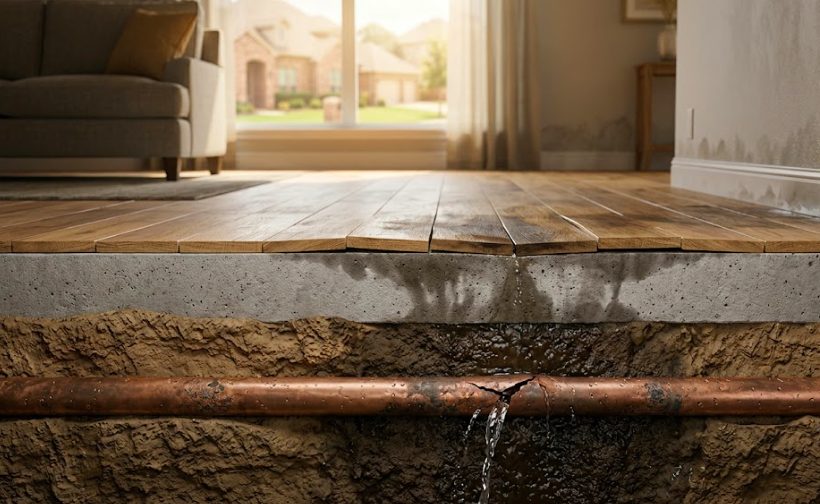
Your Lake Travis home may be silently flooding from the inside and you’d never know it. A slab leak is one of the most destructive, hardest-to-detect plumbing failures a homeowner can face. Water seeps from a broken pipe buried beneath your concrete foundation, spreading outward unseen for weeks or even months before the first visible symptom appears. By then, the damage to your flooring, foundation, and indoor air quality can run into tens of thousands of dollars.
If you own a home in Lakeway, Lake Travis, Lago Vista, Hudson Bend, or Bee Cave, understanding slab leaks isn’t optional it’s essential. The clay-heavy soils, intense summer heat, and older pipe materials common across Travis County make this region particularly vulnerable. This guide covers everything you need to know: what a slab leak is, what causes one, the warning signs to watch for, and the exact steps to take before a hidden drip becomes a structural disaster.
What Is a Slab Leak?
A slab leak is a leak that develops in the water supply lines or sewer lines that run underneath your home’s concrete slab foundation. In most Texas homes built after the 1950s, copper or galvanized steel pipes were routed directly through or beneath the concrete during construction. When one of those pipes develops a crack, hole, or joint failure, water escapes and saturates the surrounding soil and concrete.
There are two main categories:
- Hot-water line slab leaks – Often caused by corrosion, because hot water accelerates chemical reactions that break down copper pipes from the inside out.
- Sewer/drain slab leaks – Caused by root intrusion, ground shifting, or pipe deterioration; often involve contaminated water mixing with soil beneath the slab.
Both types require professional detection and repair. Neither resolves itself over time they only grow worse.
Why Slab Leaks Are Common in the Lake Travis Area
Several environmental and construction factors make slab leaks disproportionately common across Travis County:
1. Expansive Clay Soils
Central Texas sits atop a belt of expansive clay soil that swells dramatically during wet periods and contracts during drought. Austin’s notorious boom-and-bust rainfall patterns mean the ground beneath your slab is in constant motion. That movement places lateral stress on buried pipes, gradually causing fractures at joints and bends.
2. Hard Water Mineral Buildup
Lake Travis area water is notoriously high in calcium and magnesium. Over time, mineral scale builds up on the interior walls of copper pipes, weakening them and creating pressure imbalances. That internal pressure, combined with external soil movement, is a recipe for eventual failure.
3. Aging Copper and Galvanized Pipes
Many homes built in the 1970s through early 2000s used copper piping that has now reached or exceeded its typical 50-year service life. Electrolytic corrosion a chemical reaction triggered by contact between dissimilar metals or by acidic soil quietly eats through pipe walls from the outside in.
4. Poor Original Installation
Pipes installed without proper bedding material or with sharp bends under the slab are more vulnerable to abrasion and stress cracking as the home settles over decades.
8 Warning Signs You May Have a Slab Leak
Because slab leaks are buried, the symptoms are subtle at first. Watch for any combination of the following:
- Unexplained spike in your water bill – A sudden 20–40% increase in water usage without a change in household habits is the earliest financial signal.
- Sound of running water when everything is off – Turn off all faucets and appliances. If you can hear water moving, a pipe is losing pressure somewhere.
- Warm or hot spots on the floor – A hot-water line leak heats the concrete above it. Barefoot walking can detect these patches on tile or hardwood.
- Buckling, warping, or cupping hardwood floors – Wood absorbs moisture from below before it surfaces visibly. Any unexplained floor warping deserves investigation.
- Wet or damp carpet with no surface source – If carpet feels spongy or smells musty in a first-floor room, moisture may be wicking up through the slab.
- Cracks in walls or floors – As soil erodes and the slab shifts under sustained water exposure, hairline cracks appear in drywall, tile grout, and the flooring itself.
- Low water pressure throughout the home – A rupture in the main supply line beneath the slab causes a measurable drop in pressure at every fixture.
- Mold or mildew smell at floor level – Persistent moisture under a slab creates ideal conditions for mold growth inside walls and underneath flooring materials.
How a Slab Leak Damages Your Foundation
This is where a plumbing problem becomes a structural emergency. Your concrete slab doesn’t just sit on top of the ground it is engineered to distribute your home’s load evenly across compacted soil. The moment water introduces itself to that equation, the balance is disrupted.
Soil Erosion and Void Formation
Sustained water flow beneath the slab gradually washes away fine soil particles a process called soil piping or internal erosion. Over weeks and months, small voids form under sections of the slab. Without soil support, those sections flex under load, eventually cracking. In severe cases, a section of the slab can drop or heave by a quarter-inch or more.
Post-Tension Cable Corrosion
Many Lake Travis area homes use post-tensioned slab construction, where steel cables embedded in the concrete are stretched tight to add structural strength. When water reaches those cables especially if it’s slightly acidic it accelerates corrosion. A snapped post-tension cable releases enormous stored energy and can cause sudden, dramatic slab cracking.
Differential Settlement
If the leak is localized, only part of the slab loses soil support. One section drops while adjacent sections remain stable, creating differential settlement. Doors begin sticking. Windows won’t close properly. Diagonal cracks run from door corners toward the ceiling. These are signs the foundation has already moved.
Important: Foundation repair in Texas typically costs between $5,000 and $30,000+ depending on severity. Catching a slab leak before it undermines your foundation can save you from that bill entirely.
How Slab Leaks Destroy Your Flooring
Flooring is frequently the first visible casualty of a slab leak and it’s often misdiagnosed as a humidity problem or simple wear until the real source is found.
Hardwood and Engineered Wood
Wood is hygroscopic it absorbs and releases moisture in response to its environment. Moisture wicking up from a wet slab causes individual boards to expand, cup, or buckle. Once wood floors have absorbed significant moisture, structural damage is often irreversible. Full replacement rather than refinishing becomes necessary.
Tile and Grout
Ceramic and porcelain tile appears impervious, but the grout lines and adhesive mortar bed beneath are not. Sustained moisture under tile degrades the mortar bond, causing tiles to pop loose, crack, or hollow out. You may notice a hollow sound when walking on certain tiles that’s the gap where adhesion has already failed.
Carpet and Padding
Carpeting acts like a sponge and hides moisture longer than any other flooring type. By the time dampness is felt through carpet, the underlying pad has often become saturated, and mold colonies may already be established. Remediation at this stage requires full pad replacement and carpet sanitization and potentially treatment of the concrete subfloor itself.
Laminate and LVP
Laminate flooring has essentially zero moisture tolerance at the core layer. Even minor slab moisture causes laminate to swell, separate at seams, and develop permanent ridges. Luxury vinyl plank is more resilient but still vulnerable to extended subfloor saturation that creates adhesion failure or mold underneath.
The Water Damage Ripple Effect: What Happens After the Leak
A slab leak doesn’t stop at your floors. Once moisture penetrates the slab and reaches your living space, it begins migrating upward into wall cavities, insulation, and structural framing. Within 24 to 48 hours, mold spores which are always present in indoor air can begin colonizing damp drywall and wood framing. Within a week, a hidden mold colony can span several square feet inside a wall.
This is why professional water damage remediation is just as important as plumbing repair. Fixing the pipe stops the source; remediation addresses everything the water already touched. If you’re located elsewhere and dealing with the aftermath of a plumbing-related flood, the certified restoration specialists at Water Damage Restoration Akron offer a strong model of what comprehensive remediation looks like from emergency extraction and structural drying to mold inspection and complete property restoration.
For Lake Travis homeowners, your plumber and your water damage remediation team need to coordinate closely to ensure no hidden moisture pockets are left behind after slab leak repair. Failing to dry out wall cavities and flooring substrates after a slab leak is repaired is one of the most common and costly mistakes homeowners make.
Slab Leak Detection: How Professionals Find the Leak
Modern slab leak detection is non-invasive and highly accurate. A licensed plumber uses a combination of these tools to pinpoint the leak’s exact location before any concrete is touched:
- Electronic listening devices – Amplify the sound of water escaping under pressure to locate leaks within inches
- Thermal imaging cameras – Identify temperature differentials in the slab surface caused by hot-water line leaks
- Pressure testing – Isolates the specific line losing pressure to confirm a leak exists and estimate its severity
- Tracer gas detection – Inert, harmless gas is introduced into the pipe; a sensor detects where it escapes through the slab
Accurate detection is critical because it determines which repair method is appropriate and minimizes unnecessary concrete cutting.
Slab Leak Repair Methods: Which One Is Right for Your Home?
There is no single right repair method. The best approach depends on the pipe material, the leak location, its severity, and whether the pipe has a history of prior repairs. Here are the four primary options:
1. Spot Repair (Open and Patch)
The concrete is cut directly over the leak location, the damaged pipe section is replaced, and the concrete is repoured. Best for isolated, single-point leaks on pipes that are otherwise in good condition.
2. Pipe Rerouting (Overhead Re-pipe)
Rather than digging into the slab, new supply lines are routed through walls, attics, or crawlspaces. This avoids future slab access entirely and is the preferred method for homes with widespread pipe corrosion or multiple prior slab leaks.
3. Epoxy Pipe Lining (Trenchless Repair)
A flexible epoxy liner is inserted into the existing pipe and inflated, hardening against the interior walls to seal cracks from within. Suitable for pinhole leaks in copper supply lines with no major structural damage.
4. Tunneling and Full Under-Slab Repipe
For extensive under-slab plumbing replacement, tunnels are excavated beneath the home without cutting through the slab from above. This preserves finished flooring and avoids disrupting post-tension cables. It’s the most involved method but the right choice when most of the original under-slab plumbing needs replacement.
According to the Texas State Board of Plumbing Examiners, all slab leak repair work in Texas must be performed by a licensed master plumber. Always verify your contractor’s TSBPE license number before authorizing any work beneath your foundation.
What to Do If You Suspect a Slab Leak in Your Lake Travis Home
Don’t wait for the damage to become visible. Follow these steps the moment you notice any of the warning signs described above:
- Check your water meter – Turn off every water source in the house, then watch the meter for 15 minutes. If the dial moves, water is escaping somewhere in your system.
- Document everything – Photograph any floor discoloration, wall cracks, or moisture spots. This documentation is essential for your homeowner’s insurance claim.
- Call a licensed leak detection specialist immediately – Don’t attempt to break into the slab yourself. Every hour of delay allows more water to migrate into your foundation and walls.
- Notify your insurance company – Most standard homeowner’s policies cover sudden and accidental slab leaks. Gradual leaks that were knowingly ignored may not be covered.
- Avoid using affected fixtures – Minimizing water use while you wait for the plumber reduces the volume of water entering the leak.
Trust Lake Travis’s Slab Leak Experts Allstate Plumbing Heat & Air
A slab leak is not a wait-and-see situation. Every day the leak runs, your foundation, flooring, and indoor air quality are at greater risk. At Allstate Plumbing Heat & Air, we’ve spent over 15 years detecting and repairing slab leaks throughout Lakeway, Lake Travis, Lago Vista, Hudson Bend, Bee Cave, and Travis County. Our licensed plumbers use non-invasive electronic detection to find your leak’s exact location before we ever touch the concrete and we’ll walk you through your repair options in plain language so you can make a confident, informed decision.
We offer 24/7 emergency response, free estimates, and direct insurance coordination to make the process as smooth as possible for you.
Don’t let a hidden leak become a foundation failure. Call us at (737) 313-2650 today for fast, professional slab leak detection and repair across the Lake Travis area.
Frequently Asked Questions About Slab Leaks
How much does slab leak repair cost in Austin, TX?
Slab leak repair in the Austin and Lake Travis area typically ranges from $500 to $4,000 for a spot repair, $2,500 to $8,000 for pipe rerouting, and $8,000 to $25,000+ for full under-slab tunneling and repipe. The cost depends on leak location, pipe material, and which repair method is appropriate. Foundation repair caused by an untreated slab leak is a separate and significantly higher expense.
Does homeowner’s insurance cover slab leaks in Texas?
Most standard homeowner’s insurance policies cover the resulting damage from a sudden slab leak (flooring, drywall, mold remediation) but not the plumbing repair itself. Coverage depends on your specific policy and whether the leak is deemed sudden or the result of gradual neglect. Document everything and contact your insurer as soon as a slab leak is confirmed.
How long does slab leak detection take?
Professional non-invasive slab leak detection typically takes 1 to 3 hours, depending on the size of the home and the number of plumbing lines. Electronic listening devices and thermal imaging cameras allow our technicians to pinpoint the leak’s location within a few inches without any concrete cutting.
Can a slab leak cause mold?
Yes. A slab leak provides constant moisture to the underside of your flooring and the base of your walls ideal conditions for mold growth. Mold can begin developing within 24 to 48 hours of sustained moisture exposure. Professional remediation is often necessary alongside the plumbing repair to ensure no hidden mold colonies remain.
What happens if a slab leak is left untreated?
An untreated slab leak will progressively erode the soil beneath your foundation, causing voids, slab cracking, and differential settlement. Flooring materials will warp, buckle, and develop mold. Wall cracks will widen. In worst-case scenarios, structural sections of the home can become unsafe. Repair costs escalate dramatically the longer a slab leak is allowed to run.
Leave a Reply