
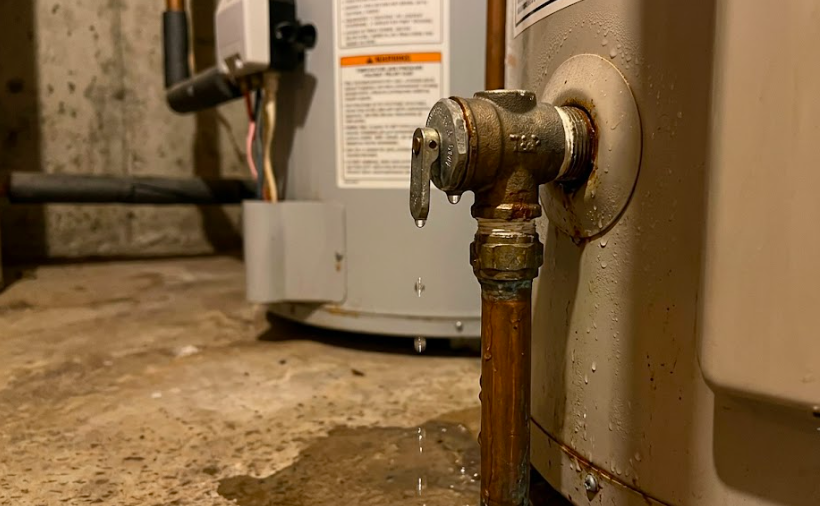
That slow drip coming from the small valve on the side of your water heater might seem harmless but ignoring it could be one of the costlier mistakes a homeowner makes. The pressure relief valve (T&P valve) is a critical safety device, and when it starts dripping, it’s trying to tell you something.
Here’s everything you need to know.
What Is a Pressure Relief Valve (T&P Valve)?
The temperature and pressure relief valve commonly called the T&P valve or PRV is a safety device installed on every residential water heater. Its entire job is to release pressure if the tank gets too hot or too pressurized.
Think of it as the last line of defense between a functioning appliance and a potential rupture.
It’s typically located on the side or top of the water heater, with a discharge pipe running downward toward a floor drain.
Why Is My Pressure Relief Valve Dripping?
A dripping T&P valve isn’t always a sign of failure but it always warrants investigation. The most common causes include:
1. High Water Pressure
If your home’s incoming water pressure exceeds 80 PSI, the tank is under chronic stress. The T&P valve will intermittently open to relieve that excess pressure, causing the drip you see. Normal residential pressure should sit between 40–60 PSI.
A pressure reducing valve (PRV) on your main line can solve this. A licensed plumber can test your line pressure in minutes.
2. Thermal Expansion
When cold water enters a closed plumbing system and heats up, it expands. Without an expansion tank to absorb that growth, pressure builds inside the water heater and the T&P valve releases it.
This is increasingly common in homes with check valves or backflow preventers installed on the main line, which create what’s called a closed system.
3. A Faulty or Aging T&P Valve
T&P valves have a lifespan of roughly 3–5 years under normal conditions. Over time, the internal spring weakens and the valve seat can degrade, causing it to weep even at normal pressures. If your water heater is older, the valve may simply be worn out.
4. Water Heater Set Too High
If your water heater’s thermostat is set above 120°F (49°C), the unit runs hotter than necessary, building more pressure and triggering the valve more often. The U.S. Department of Energy recommends 120°F as the sweet spot for safety and efficiency.
5. Sediment Buildup in the Tank
Mineral deposits accumulate at the bottom of water heater tanks over years of use. This sediment layer can cause uneven heating, temperature spikes, and elevated pressure all of which put additional stress on the T&P valve.
Is a Dripping Pressure Relief Valve Dangerous?
Short answer: it can be and you should not ignore it.
Here’s the risk spectrum:
| Scenario | Risk Level |
|---|---|
| Valve drips briefly after hot water use | Low – may be normal thermal expansion |
| Valve drips continuously | Moderate – indicates sustained overpressure |
| Valve is stuck open or leaking heavily | High – immediate plumber call needed |
| Valve is blocked, capped, or bypassed | Critical – explosion/flood risk |
The danger isn’t the dripping itself it’s what the dripping signals. A T&P valve that trips repeatedly is working as designed. But a blocked or capped valve that can’t open is genuinely dangerous. Water heaters under extreme pressure can rupture or even explode.
According to the U.S. Consumer Product Safety Commission, water heater failures cause thousands of home injuries and significant property damage annually most of which are preventable with routine maintenance.
What Should You Do?
Step 1 – Don’t Cap or Plug the Valve
This is the most dangerous DIY fix homeowners attempt. Blocking the valve eliminates the only pressure relief mechanism. Never do this.
Step 2 – Test the Valve (Carefully)
Lift the test lever briefly (for 1–2 seconds) to verify it opens and reseats properly. If it doesn’t reseat meaning water keeps flowing after you release the lever the valve needs to be replaced immediately.
The discharge water is scalding hot. Keep hands clear of the pipe.
Step 3 – Check Your Water Pressure
Purchase a simple pressure gauge at any hardware store and attach it to an outdoor spigot. If pressure is above 80 PSI, contact a plumber to install or adjust a pressure reducing valve.
Step 4 – Lower the Thermostat
If your heater is set above 120°F, turn it down. This alone can reduce valve activity significantly.
Step 5 – Have a Plumber Inspect and Replace the Valve
T&P valves should be replaced every 3–5 years as preventive maintenance more often if you’re in an area with hard water. A licensed plumber can replace one in under an hour, and the part itself is inexpensive.
What Happens If the Valve Fails Completely?
If a T&P valve fails in the open position, water continuously drains from the discharge pipe and what’s draining often ends up on your floor. What starts as a plumbing issue can quickly become water damage affecting subfloor, drywall, and insulation.
If the valve fails in the closed position (stuck shut), and pressure continues to build the results can range from a ruptured tank to catastrophic flooding.
In either scenario, the water cleanup that follows is typically extensive. Homeowners in South Texas dealing with this kind of water heater leak damage can contact FloodFix Solutions – McAllen’s water damage restoration specialists for rapid extraction and drying services.
Preventive Maintenance Checklist
Keep your water heater and your home safe with this annual routine:
- Test the T&P valve lever once per year
- Check incoming water pressure (should be 40–60 PSI)
- Flush the tank annually to remove sediment
- Inspect the discharge pipe it should terminate safely near a drain
- Replace the T&P valve every 3–5 years
- Verify your expansion tank is properly sized if you’re on a closed system
When to Call a Professional
Call a licensed plumber immediately if:
- The T&P valve won’t reseat after testing
- You see water pooling around the base of the heater
- The discharge pipe is capped, missing, or directed toward the wall
- Your water pressure reads above 80 PSI
- The water heater is making rumbling, popping, or hissing sounds
Don’t wait on this one. A $15 valve replacement today beats a flooded utility room and thousands in remediation tomorrow.
Frequently Asked Questions
Can I replace the T&P valve myself?
Technically yes, but it involves draining the tank and working with hot water lines. Most homeowners are better served having a licensed plumber handle it to ensure correct sizing and code compliance.
How long does a water heater T&P valve last?
Most manufacturers recommend replacement every 3–5 years, regardless of whether it’s visibly leaking.
Is a dripping T&P valve covered by homeowners insurance?
Gradual leaks are typically excluded from standard policies. Sudden failures that cause water damage may be covered but this varies by insurer. Always review your policy language.
What size T&P valve do I need?
The replacement valve must match the BTU rating and pressure rating stamped on your existing valve (typically 150 PSI / 210°F for residential units). A plumber will confirm the correct spec.
For emergency water heater repairs, water damage restoration, or a full plumbing inspection in the Rio Grande Valley, explore our services at allstateplumbingheatandairlaketravis.com.
Leave a Reply