Fast Fact: The Insurance Institute for Business & Home Safety reports that plumbing supply line failures are among the top five causes of residential water damage costing homeowners an average of $5,000–$50,000+ in repairs when left undetected.
Walk into your bathroom right now. Crouch down and look behind your toilet tank. That small, corrugated hose connecting the wall shut-off valve to the bottom of the tank? It’s called the toilet supply line and most homeowners have never once given it a second thought.
That’s exactly the problem.
Unlike a burst pipe that announces itself with a wall of water, supply line failures often begin as a slow weep undetected behind cabinetry, under flooring, or inside walls. By the time you smell mildew or notice a warped baseboard, the structural damage and mold growth may already be extensive.
At Allstate Plumbing Heat & Air Lake Travis, we respond to these calls more than you’d think. And when catastrophic flooding does occur when a supply line fully fails the resulting water damage can reach multiple rooms, affect subfloors, drywall, and insulation, and demand immediate professional restoration.
Why Toilet Supply Lines Are So Dangerous
The toilet supply line is always under pressure 24 hours a day, 7 days a week. Unlike a faucet or shower valve, there’s no off between uses. The water pressure inside that line never drops unless you manually shut off the valve. This constant hydraulic stress gradually degrades the internal material, especially in older plastic or low-quality braided stainless lines.
Three specific failure modes make them uniquely hazardous:
- Slow seeping leaks – Micro-fractures develop at the coupling ends, releasing a trickle that saturates subfloor materials over months
- Sudden burst failure – The outer braid ruptures entirely, releasing full line pressure into your bathroom uninterrupted
- Valve seat corrosion – The shut-off valve itself corrodes and becomes impossible to fully close, turning any repair into a bigger emergency
According to the Insurance Institute for Business & Home Safety (IBHS), supply line failures account for a disproportionate share of plumbing-related water damage claims largely because they’re out of sight and out of mind until a major failure occurs.
Warning Signs You Should Never Ignore
Your home is usually trying to tell you something is wrong long before a supply line fully fails. Learn to read these signals:
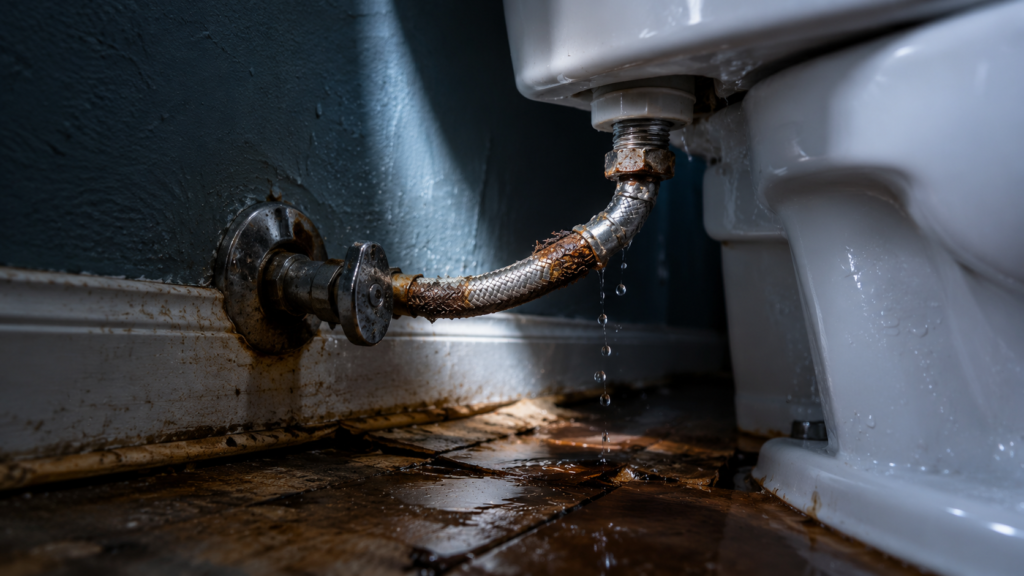
- Rust-colored staining around the base of the toilet or under the tank connection a sign of mineral buildup from a slow, cycling leak
- Soft or spongy floor tiles near the toilet subfloor saturation long precedes visible surface damage
- Musty or earthy odor in the bathroom even after cleaning active mold colonies almost always have a water source behind them
- Unexplained water bill increases a persistent slow leak of even 1 drop per second wastes 3,000+ gallons per year
- Visible corrosion or kinking on the supply line hose itself inspect for discoloration, bubbling of the outer braid, or any deformity
- A shut-off valve that’s stiff or won’t turn, if you can’t close the valve in an emergency, a minor failure becomes catastrophic
What Happens When a Line Fully Fails
A supply line that bursts doesn’t just create a puddle. Within minutes, water migrates through grout lines into your subfloor. Within an hour, it can seep through the ceiling below, damage electrical components, soak insulation, and wick into wall framing. Within 24–48 hours, mold begins to colonize the wet materials invisibly, aggressively, and in ways that make remediation exponentially more complex.
If you’re in Akron or Northeast Ohio and experience a sudden bathroom flood, immediate professional water damage restoration is critical. The team at Akron OH Water Damage Restoration specializes in exactly this type of emergency rapid extraction, structural drying, and mold prevention protocols that stop secondary damage from compounding the original loss. Don’t wait to call; every hour of delay increases the remediation scope and cost significantly.
Professional Insight
The Federal Emergency Management Agency (FEMA) notes that water damage is the second most common homeowner insurance claim in the U.S. Most supply line failures are covered but only if the damage is reported and remediated promptly. Delayed claims can be denied as “negligent maintenance.” Learn more at FEMA’s flood insurance resource center.
How Long Do Toilet Supply Lines Last?
The answer depends almost entirely on the material:
- Plastic/PVC lines: 5–8 years. These degrade from UV exposure, temperature cycling, and chlorine in municipal water. Avoid them entirely.
- Chrome-plated brass lines: 8–10 years. Better, but coupling threads are still vulnerable to corrosion over time.
- Polymer-core braided stainless lines: 10–12 years. The industry standard but the inner polymer tube still degrades, even if the outer braid looks fine.
- Corrugated stainless steel (no inner liner): 15–20 years. The most durable option for residential use.
Industry guidance from the Plumbing-Heating-Cooling Contractors Association (PHCC) recommends replacing supply lines proactively every 8–10 years regardless of visible condition because internal polymer degradation isn’t visible from the outside.
How to Inspect Your Toilet Supply Lines Right Now
This takes less than five minutes and costs nothing:
- Turn off the bathroom light and use a flashlight – Better illumination reveals staining and corrosion that ambient light conceals.
- Feel the line along its entire length – Any soft spots, kinking, or unusual texture indicates internal degradation.
- Check both coupling ends – Look for green or white mineral deposits, rust streaks, or any evidence of moisture around the threaded connections.
- Test the shut-off valve – Turn it gently clockwise it should move smoothly and fully stop water flow. If it’s stiff, frozen, or leaks when you turn it, have it replaced immediately.
- Press gently on the floor at the toilet base – Any flex, softness, or sound of water means subfloor saturation is already in progress.
- Check the tank fill valve connection – Inspect where the supply line enters the bottom of the tank; this junction is a common failure point.
Replacing a Toilet Supply Line: What You Need to Know
Supply line replacement is one of the few plumbing tasks a confident DIYer can complete but only under the right conditions. If your shut-off valve works properly, the old line threads out cleanly, and you’re comfortable with hand-tightening compression fittings, a quality braided stainless replacement can be installed in under 30 minutes.
However, call a licensed plumber if any of the following apply:
- The shut-off valve is corroded, stiff, or leaking
- You notice existing water damage to the floor or wall
- The supply line coupling is fused to the valve (do not force it)
- Your home’s water pressure exceeds 80 PSI (install a pressure regulator first)
- The toilet is original to a home built before 1995 (connections may use obsolete sizing)
At Allstate Plumbing Heat & Air Lake Travis, our licensed plumbers inspect not just the supply line but the complete toilet assembly, shut-off valve condition, and surrounding floor structure catching problems that a simple line swap would leave behind.
After the Flood: The Restoration Process
If a supply line failure has already caused water damage in your home, the remediation process follows a precise sequence that professionals execute with industrial equipment and timing matters enormously:
- Emergency water extraction – High-powered wet vacuums and extraction units remove standing and absorbed water from flooring and subfloor materials
- Moisture mapping – Thermal imaging cameras and moisture meters identify the full extent of saturation, including hidden pockets inside walls
- Structural drying – Industrial air movers and dehumidifiers run continuously, often for 3–5 days, to bring all materials below the mold-growth threshold
- Antimicrobial treatment – EPA-registered antimicrobial applications prevent mold colonization in affected materials
- Demolition and replacement – Saturated drywall, flooring, and subfloor sections that cannot be dried in-place are removed and rebuilt
- Documentation for insurance – Professional restoration companies provide complete moisture logs, photo documentation, and scope reports for insurance claims
For Akron homeowners, this is precisely the kind of comprehensive response that Akron OH Water Damage Restoration delivers from the first emergency call through final rebuild. Their local presence means faster response times, which directly limits structural damage and mold risk.
Prevention Checklist
Add these to your annual home maintenance routine: Replace supply lines every 8–10 years · Test shut-off valves annually · Check lines after hard freezes · Install a whole-home water leak detector · Know where your main water shut-off is before you need it.
The Case for Automatic Shut-Off Technology
Smart home leak detection has advanced dramatically. Whole-home water shut-off systems devices like Moen’s Flo or Phyn Plus continuously monitor flow patterns and can detect the micro-flow of a slow supply line leak, alerting you via smartphone and automatically shutting off your main water supply if a burst is detected.
For homeowners who travel frequently, have elderly family members who may not notice early leak signs, or own vacation properties, these systems offer genuine protection against catastrophic loss. A device that costs a few hundred dollars can prevent tens of thousands in damage and the peace of mind is difficult to quantify.
Frequently Asked Questions
How do I know if my supply line is the braided type that fails?
Look for a silver-colored woven mesh exterior. If you see a plain white or gray plastic hose, that’s even more urgent to replace. it’s the most failure-prone type. Braided stainless is the silver mesh style, and it’s still the best consumer-grade option available.
Can a slow leak dry on its own?
No. A leaking supply line requires constant pressure to weep the leak will not stop, and the underlying material damage will only worsen. Even a tiny drip should be addressed same-day.
My floor feels slightly soft near the toilet – is that a big deal?
Yes. Subfloor softness means moisture has already penetrated the underlayment or structural wood below your tile or vinyl. This requires professional moisture mapping to understand the true scope, and likely subfloor repair or replacement in affected sections.
Does homeowners insurance cover supply line failure?
Most standard homeowners policies cover sudden and accidental water damage from supply line failure but not gradual damage resulting from a slow leak that went unaddressed. This is why prompt reporting and professional documentation are critical.
Noticed a Warning Sign? Don’t Wait.
Our Lake Travis plumbing team inspects supply lines, shut-off valves, and the complete toilet assembly catching failure points before they become flood events. Same-day appointments available.Schedule a Plumbing Inspection →
Leave a Reply