If your water heater is making popping or rumbling noises, running out of hot water faster than it used to, or your energy bills have been creeping up without explanation hard water may be the culprit. It’s one of the most overlooked threats to a water heater’s lifespan, and it silently causes damage long before any visible signs appear.
Here’s everything you need to know about what hard water does to your water heater, how to recognize the warning signs early, and what you can do to protect your investment.
What Is Hard Water, and Why Does It Matter?
Hard water contains elevated concentrations of dissolved minerals primarily calcium and magnesium picked up as groundwater flows through limestone and chalk deposits. According to the U.S. Geological Survey, approximately 85% of American homes are supplied with hard water.
The hardness level is measured in grains per gallon (GPG) or milligrams per liter (mg/L):
| Hardness Level | GPG | mg/L |
|---|---|---|
| Soft | < 1 | < 17 |
| Slightly Hard | 1–3.5 | 17–60 |
| Moderately Hard | 3.5–7 | 60–120 |
| Hard | 7–10.5 | 120–180 |
| Very Hard | > 10.5 | > 180 |
On its own, hard water is not a health hazard. But for plumbing systems and water heaters in particular it’s quietly destructive.
How Mineral Buildup Damages Your Water Heater
When hard water is heated, the dissolved calcium and magnesium carbonate separate from the water and precipitate as solid scale deposits. This process accelerates significantly at temperatures above 140°F, which is why your water heater is ground zero for scale accumulation.
1. Scale Builds Up on the Heating Element or Tank Floor
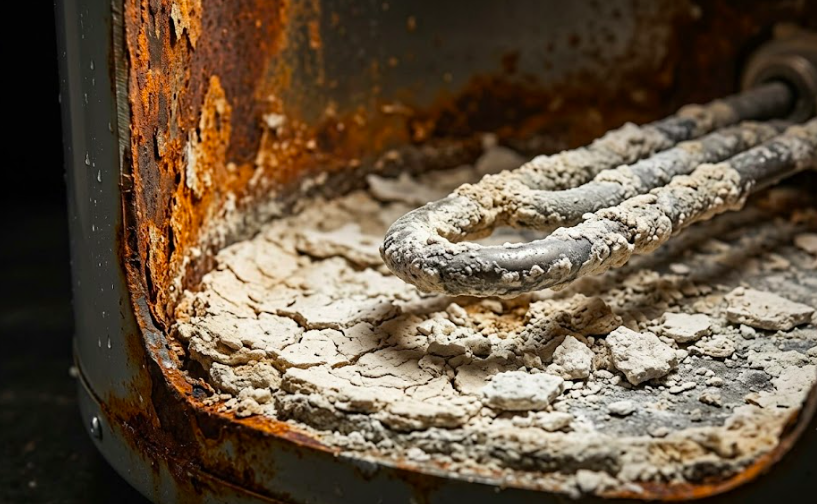
In electric water heaters, scale encases the lower heating element, forcing it to work harder to transfer heat through the insulating layer of mineral crust. In gas water heaters, sediment accumulates on the tank floor directly above the burner, acting as a thermal barrier between the flame and the water.
The result is the same in both cases: longer heating cycles, higher energy consumption, and accelerated wear on components.
2. Tank Corrosion Worsens Over Time
Scale isn’t inert. As it cracks and shifts with the thermal expansion and contraction of normal heating cycles, it exposes raw metal surfaces to oxygenated water the exact conditions needed for rust to form. Once corrosion takes hold inside a tank, it cannot be reversed. Rust particles in the water supply and eventual tank failure are the end result.
The Water Quality Association notes that scale buildup in plumbing and water heating equipment is one of the leading causes of premature appliance failure in hard water areas.
3. Pressure Relief Valve Stress
Sediment buildup raises water temperature unevenly inside the tank. Hot spots near the burner or element cause localized overheating, which increases pressure inside the unit. The pressure relief (T&P) valve your water heater’s critical safety component is then subjected to pressure spikes it wasn’t designed to handle on a daily basis, shortening its service life.
4. Anode Rod Depletion Accelerates
The sacrificial anode rod inside your water heater is designed to corrode in place of the tank walls it’s your first line of defense against internal rust. In hard water conditions, the high mineral content accelerates anode rod depletion significantly. A rod that might last 4–5 years in soft water can be consumed in under 2 years in a very hard water area.
Once the anode rod is gone and goes unnoticed, tank corrosion begins rapidly.
Warning Signs Your Water Heater Is Suffering from Scale Buildup
Catch these early and you can intervene before costly damage is done:
- Popping, rumbling, or crackling sounds – Trapped water bubbling through sediment layers on the tank floor. This is the most common and distinctive symptom.
- Reduced hot water supply – Sediment displaces water volume in the tank; the usable capacity shrinks even though the tank size hasn’t changed.
- Longer recovery times – The heater takes noticeably longer to reheat after a shower or dishwasher cycle.
- Rising energy bills – A scale layer as thin as 1/4 inch can reduce heating efficiency by up to 40%, according to studies cited by the Department of Energy.
- Discolored or metallic-tasting hot water – Rust-colored water or a metallic taste from the hot tap is a sign of internal corrosion already in progress.
- White or gray scale deposits on fixtures – If you’re seeing heavy buildup on faucet aerators, showerheads, and around drains, your water heater is experiencing the same thing internally.
How Hard Water Shortens Water Heater Lifespan
A properly maintained water heater in a soft water area can last 12–15 years. In a hard water area without any mitigation measures, that lifespan can drop to 6–8 years or even less in very hard water zones.
The math is straightforward: scale buildup forces the unit to run longer to reach set temperature, generating more heat cycles per day. More heat cycles mean more stress on the tank, more expansion and contraction of welds and connections, and faster depletion of protective components like the anode rod.
This isn’t a worst-case scenario. It’s standard operating reality for millions of homeowners in hard water regions across the U.S.
What You Can Do: Prevention and Mitigation
Flush the Tank Annually (At Minimum)
Draining 1–2 gallons from the tank’s drain valve once a year removes loose sediment before it has a chance to harden and bond to the tank floor. In very hard water areas, flushing every 6 months is advisable.
How to do it:
- Turn off the cold water supply to the heater
- Attach a garden hose to the drain valve and run it to a floor drain
- Open a hot water faucet somewhere in the house to prevent a vacuum
- Open the drain valve and let water run until clear
- Close the valve, restore the water supply, and allow the tank to refill before relighting the pilot or restoring power
Inspect and Replace the Anode Rod
Check the anode rod every 2–3 years (more frequently in hard water). If it’s less than 1/2 inch thick or heavily coated with calcium carbonate, replace it. This is a straightforward DIY task that can add years to your tank’s life.
Lower the Thermostat to 120°F
The EPA and most plumbers recommend 120°F as the optimal water heater temperature. Dropping from 140°F to 120°F dramatically slows the precipitation rate of calcium and magnesium minerals, reducing scale formation significantly.
Install a Water Softener
A whole-house water softener is the most effective long-term solution for hard water. Ion exchange softeners replace calcium and magnesium ions with sodium, delivering softened water throughout your plumbing system. This essentially eliminates scale formation inside the water heater.
For homes with very hard water (above 10 GPG), a water softener typically pays for itself in extended appliance lifespan and reduced energy costs within 3–5 years.
Consider a Tankless Water Heater
Tankless (on-demand) water heaters are less vulnerable to sediment accumulation simply because water doesn’t sit and heat repeatedly inside a tank. They still require descaling maintenance in hard water areas, but typically have longer service lives and better efficiency retention over time.
When Water Heater Problems Become a Bigger Emergency
Left unaddressed, a failing water heater doesn’t just stop working it can fail catastrophically. A corroded tank can develop pinhole leaks that go unnoticed for weeks, slowly saturating the surrounding flooring, subfloor, drywall, and framing. By the time the water becomes visible, significant structural damage and mold growth may already be underway.
This is especially true for water heaters installed in finished basements, utility closets, or areas with limited visibility. A small, slow leak from a corroded fitting or the tank base can cause thousands of dollars in water damage before it’s detected.
If you’ve experienced a water heater leak or appliance-related water intrusion in the Akron, Ohio area, the team at Akron OH Water Damage handles emergency water extraction, structural drying, and full restoration including situations originating from appliance failures.
Quick Reference: Hard Water Impact Summary
| Problem | Cause | Effect on Water Heater |
|---|---|---|
| Scale on heating element | Mineral precipitation | Higher energy use, element burnout |
| Sediment on tank floor | Settled calcium/magnesium | Uneven heating, hot spots, tank stress |
| Accelerated anode rod loss | High mineral activity | Early internal corrosion |
| T&P valve stress | Temperature/pressure spikes | Valve failure risk |
| Reduced capacity | Sediment displaces water volume | Less hot water per cycle |
Final Word
Hard water and water heaters are a slow-moving problem the damage accumulates quietly over months and years, and most homeowners don’t notice until the unit fails entirely or a leak causes visible damage. Annual maintenance, a lower thermostat setting, and periodic anode rod inspection are low-effort, high-return habits that can extend your water heater’s life by years.
If you’re in a hard water region and haven’t had your water heater serviced recently, now is the right time to start.
Need water heater repair or replacement? Our team serves homeowners across the region with fast, reliable service. Contact us today to schedule an inspection or get an estimate.
Related reading: Water Heater Replacement vs. Repair: How to Decide
Leave a Reply