
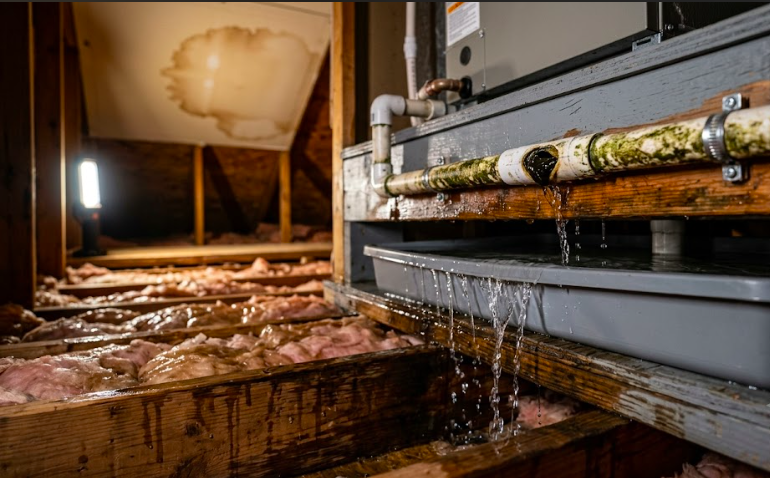
Your air conditioner is working hard right now pulling heat out of your home, running almost nonstop through Central Texas summers, and quietly doing something most homeowners never think about: draining gallons of water every single day.
That water has to go somewhere. When it can’t, it goes where you least want it: into your ceilings, walls, and floors.
AC condensate line clogs are one of the most common and most underestimated causes of water damage in Texas homes. Unlike a burst pipe or a visible leak, a clogged drain line builds pressure slowly, silently, and invisibly until the overflow hits your drywall, your insulation, your flooring, and your bank account.
Here’s everything Lake Travis and Austin homeowners need to know about condensate line clogs before they turn into a disaster.
What Is the AC Condensate Line and Why Does It Clog?
When your air conditioner runs, it pulls warm, humid air across a cold evaporator coil. Moisture from that air condenses on the coil (just like a cold glass of iced tea sweats in July) and drips into a drain pan below. From there, it flows out through the condensate drain line typically a PVC pipe and exits the home.
In Central Texas, this system handles a serious workload. A standard residential AC unit can produce 5 to 20 gallons of condensate per day during peak summer months. Over a long cooling season, that’s hundreds of gallons flowing through a single small drain line.
The problem? Condensate lines are a perfect environment for biological growth. The combination of moisture, darkness, and the nutrients carried in condensation creates ideal conditions for:
- Algae buildup (the most common culprit)
- Mold and mildew growth inside the line
- Dust, dirt, and debris accumulation at bends and joints
- Mineral deposits from hard water a particular issue in the Lake Travis area
Over time, this buildup narrows the line. Eventually, it blocks it entirely. When that happens, the water has nowhere to go except backward into the drain pan, and eventually over the edge.
The Hidden Damage a Clogged Condensate Line Causes
This is the part most homeowners don’t see coming. When a condensate line clogs and the drain pan overflows, the water doesn’t announce itself. It seeps into:
Ceiling drywall and insulation-If your air handler is in the attic (as many are in Lake Travis homes), overflow water soaks through insulation and into the ceiling below. By the time you notice a stain, the damage above it is often far worse.
Wall cavities-Water follows gravity and finds paths through gaps in framing, electrical boxes, and wall cavities, saturating materials that won’t dry on their own without professional intervention.
Subfloor and flooring-In homes where the air handler is in a closet or utility room, overflow water can pool beneath flooring, warping hardwood, lifting tile grout, or saturating concrete slabs.
Structural framing-Wood joists and studs that stay wet long enough begin to rot, compromising the structural integrity of ceilings and floors.
Electrical systems-Water near electrical wiring, junction boxes, or panels creates a serious safety hazard.
And perhaps most critically: mold. According to the EPA, mold can begin developing on wet building materials within 24 to 48 hours. A condensate line that’s been slowly overflowing for even a few days creates the perfect conditions for mold colonies to establish inside walls and ceilings completely out of sight until remediation becomes necessary.
Warning Signs Your Condensate Line Is Clogged
Because the damage happens inside your walls and ceiling, the visible warning signs often appear late. But they do appear. Watch for:
- Water stains or discoloration on ceilings near your air handler or vents-Often the first visible sign, appearing as brown or yellowish rings
- A musty smell from your vents or near the indoor unit-Algae and mold inside a clogged drain line produce a distinctive odor that gets circulated through your system
- Your AC shutting off unexpectedly-Most modern systems have a safety float switch that cuts power when the drain pan fills. If your system is cycling off for no apparent reason, this could be why
- Visible water pooling near the indoor air handler-Whether in the attic, a utility closet, or a ceiling-mounted unit, any standing water near the unit warrants immediate attention
- High indoor humidity even with the AC running-A backed-up drain line means your system can’t properly remove moisture from the air
- Soft, bubbling, or warped drywall-Near the air handler location, this indicates water has already been soaking in for some time
Don’t wait for multiple symptoms to appear. A single wet ceiling stain near your air handler is enough reason to call an HVAC professional immediately.
Why Lake Travis and Austin Homes Face Elevated Condensate Risk
Not every home is equally at risk and Central Texas homeowners have specific conditions that make condensate line clogs more likely and more damaging:
Long cooling seasons. Lake Travis AC systems run hard from April through October, sometimes beyond. More runtime means more condensate produced and more biological material accumulating in drain lines annually.
High ambient humidity near the lake. Homes near Lake Travis, Hudson Bend, Lakeway, and Spicewood manage higher moisture loads than inland properties. The more moisture in the air, the more condensate your system produces and the faster biological growth accumulates in your drain line.
Hard water mineral content. The Lake Travis area is known for hard water. Those same minerals that leave buildup in your pipes and appliances also accumulate inside condensate lines, narrowing them over time and making biological clogs worse.
Attic-mounted air handlers. A significant number of homes in the Lake Travis area have indoor air handlers installed in the attic either for space reasons or as part of original construction. When condensate overflows in an attic, water can soak into insulation, ceiling joists, and ceiling drywall across a wide area before it becomes visible. By the time you see a stain on your ceiling, significant hidden damage may already exist.
How to Prevent AC Condensate Line Clogs: A Practical Guide for Homeowners
Prevention is dramatically cheaper than repair. These steps can significantly reduce your risk:
Flush the Drain Line Every 3 Months During Cooling Season
Pour a cup of white vinegar or a diluted bleach solution (1 part bleach to 10 parts water) directly into the condensate drain access port usually a capped PVC fitting near your indoor unit. This kills algae and mold before they can build up. Do this at the start of the season and every three months through October.
Schedule Annual Professional HVAC Maintenance
A professional tune-up should include inspection and clearing of the condensate drain system. Given the length of Central Texas cooling seasons, biannual maintenance (spring and fall) is worthwhile for most Lake Travis homeowners. Technicians can identify partial clogs before they become complete blockages.
Know Where Your Secondary Drain Line Exits
Most properly installed systems include a secondary (overflow) drain line as a backup. It typically exits through an exterior wall or soffit at a different location than the primary drain. Know where yours is if you ever see water dripping from it, your primary line is clogged and you need service immediately.
Install a Condensate Float Switch
If your system doesn’t have one, a condensate float switch is a relatively inexpensive safety device that automatically shuts off your AC when water in the drain pan reaches a dangerous level, preventing overflow before it can happen. For attic-mounted air handlers especially, this is a critical safety feature.
Check the Drain Pan Monthly During Peak Season
During June through September, take 60 seconds to visually check the drain pan under your air handler. Any standing water even a small amount means drainage isn’t working properly and service is needed.
Change Your Air Filter on Schedule
A clogged air filter restricts airflow across the evaporator coil, which can cause the coil to freeze. When a frozen coil thaws, it releases far more water than the drain system can handle at once, often overwhelming the pan and drain line together. Most Lake Travis homes should be changing filters every 30–60 days during heavy-use months.
What to Do If You Discover Condensate Overflow Damage
If you find water stains, wet drywall, or visible overflow from your AC system, move quickly:
- Turn off the AC-at the thermostat and at the breaker to stop adding more water to the system
- Call an HVAC professional-to diagnose and clear the clog and inspect the condensate system
- Photograph everything before any cleanup or repairs begin documentation is critical for insurance claims
- Start drying immediately-using fans, dehumidifiers, or open windows if outdoor humidity allows
- Assess the damage honestly-if water has reached walls, insulation, ceilings, or flooring, you need a professional damage assessment, not just surface drying
Surface drying is rarely enough. Water that has soaked into drywall, insulation, and framing requires professional moisture measurement and controlled drying to fully remediate. If building materials stay wet for more than 24–48 hours, mold remediation becomes part of the equation.
For homeowners dealing with overflow damage that has spread into walls or structure, the expertise of a water damage restoration professional is essential. The team at Akron Water Damage Restoration demonstrates exactly the kind of rapid-response, moisture-measurement-driven approach that water damage situations require using thermal cameras and industrial drying equipment to address what you can’t see, not just what you can. Whether you’re in Austin or anywhere else, that methodology is the benchmark for how AC overflow damage should be handled professionally.
Locally, Allstate Plumbing Heat & Air handles the HVAC side of the equation diagnosing the condensate system, clearing the clog, and restoring proper drainage before additional water enters your home.
The Cost of Waiting vs. Acting Now
Here’s the honest financial picture. Clearing a clogged condensate drain line during a routine service call typically costs a fraction of what even minor water damage remediation runs.
Once water has soaked into:
- Ceiling drywall-replacement and repainting runs hundreds to thousands depending on scope
- Attic insulation-full replacement often required once contaminated
- Structural framing-wood rot remediation and replacement
- Mold remediation-depending on spread, this alone can run $3,000 to $30,000+
The clog itself costs almost nothing to prevent. The damage it causes can cost more than the entire HVAC system is worth.
Trust Allstate Plumbing Heat & Air to Protect Your Home
At Allstate Plumbing Heat & Air, we’ve been serving Austin and Lake Travis homeowners for over 15 years. We understand the specific demands Central Texas summers place on your HVAC system and the specific vulnerabilities that come with them.
Our HVAC maintenance service includes complete condensate system inspection: drain line flushing, drain pan condition check, float switch verification, and airflow testing to catch the conditions that lead to clogs before they cause overflow.
If you’re already seeing warning signs a water stain, a musty smell, an AC that keeps shutting off don’t wait. Call us at (737) 313-2650 or schedule your inspection online. We serve Lake Travis, Lakeway, Spicewood, Hudson Bend, Steiner Ranch, Austin, and the surrounding areas with same-day and emergency service.
Your AC should cool your home. It shouldn’t flood it.
Leave a Reply