
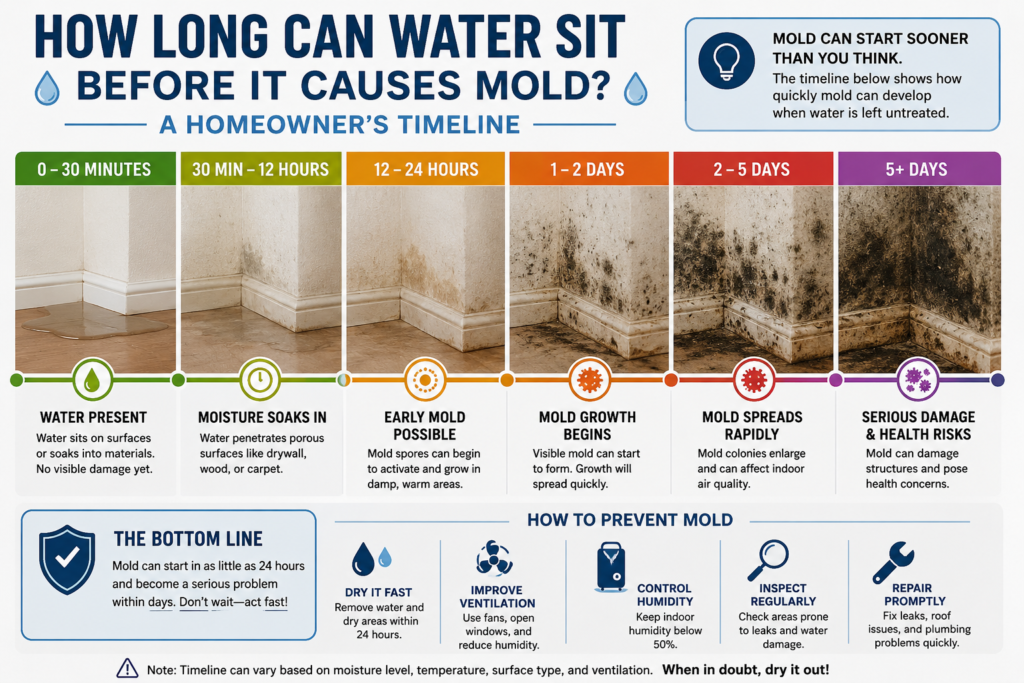
If you’ve ever found a damp spot under the sink, a soggy patch of carpet, or water pooling near the water heater, you’ve probably asked yourself the same question every homeowner asks: how much time do I actually have before this turns into a mold problem?
The answer isn’t “eventually.” It’s faster than most people think and the timeline matters, because what you do in the first few hours often determines whether you’re dealing with a quick cleanup or a much bigger, more expensive remediation job.
Here’s the realistic timeline, based on how mold actually behaves once water gets where it shouldn’t be.
Hour 0-24: The Golden Window
Mold spores are already present in virtually every home they’re in the air, on surfaces, everywhere. They just need moisture and time to activate. In the first 24 hours after a leak, spill, or flood, conditions usually aren’t wet or humid enough yet for spores to germinate and start colonizing.
This is your best window to prevent a mold problem entirely. If you can dry the area completely within this window pull up wet carpet, run fans, use a dehumidifier, wipe down wet drywall and cabinetry you can often avoid mold growth altogether.
What causes this stage in most homes we service:
- A slow leak under a sink or around a toilet base
- A water heater that’s started to weep or fail
- A washing machine supply line leak
- An AC condensate line backing up
Hour 24-48: Mold Starts to Take Hold
If materials are still wet at this point, conditions are now favorable for mold spores to germinate. You likely won’t see visible growth yet, but it’s actively starting usually inside wall cavities, under flooring, or inside cabinetry, where you can’t see it happening.
You may start to notice a musty smell before you see anything visible. That smell is a real signal, not a false alarm it usually means moisture has been sitting somewhere out of sight longer than 24 hours.
Hour 48-72: Visible Growth Begins
By the 48-72 hour mark, in most indoor environments (roughly 70-90°F with elevated humidity), mold colonies become visible as fuzzy or discolored patches often black, green, or white, depending on the species and surface. This typically shows up first on porous materials: drywall paper, wood, carpet padding, and insulation.
Once you’re at this stage, simply “drying it out” is no longer enough. The mold is established in the material itself, not just sitting on top of the moisture.
1 Week+: Structural and Air Quality Concerns
Left untreated beyond a week, mold colonies expand, can spread through wall cavities and HVAC systems, and begin actively releasing spores into the air your family breathes. At this stage, materials like drywall, subfloor, and insulation are often more cost-effective to remove and replace than to try to clean.
So What Should You Actually Do?
If you catch it in the first 24 hours: This is squarely plumbing territory. Shut off the water source, mop up standing water, run fans and a dehumidifier, and get any leaking fixture, pipe, or appliance repaired immediately. A fast plumbing fix at this stage is genuinely often all you need.
If it’s been longer than 24-48 hours, or the water came from a larger event (a burst pipe, water heater failure, or flooding): This is where it’s worth bringing in a dedicated water damage and restoration team. Professional restoration companies have moisture meters, thermal imaging, and industrial drying equipment that can detect and dry water hidden inside walls and subfloors the kind of hidden moisture a homeowner (or even a plumber) can’t fully address with fans alone. For a more detailed breakdown of what professional drying and mold prevention actually involves, Akron Ohio Water Damage has a good overview of the restoration process and timeline homeowners can expect.
This general window lines up with the U.S. EPA’s own guidance on mold and moisture: if wet or damp materials are dried within 24-48 hours of a leak or spill, mold will not grow in most cases.
The Real Takeaway
Speed matters more than almost anything else here. A leak that gets caught and dried within a day is usually a non-event. The same leak, ignored for a week, can turn into torn-out drywall, replaced flooring, and a mold remediation bill.
If you notice a leak, a musty smell, or standing water anywhere in your home, don’t wait to find out which stage of this timeline you’re in. Contact All State Plumbing, Heat & Air for fast leak detection and repair in the Lake Travis area catching the source early is still the single best way to avoid a mold problem altogether.
Leave a Reply