Pipe burst right now? Do these first:
Shut off your main water valve immediately. Turn off electricity to flooded areas at your breaker box. Then call a licensed plumber Allstate Plumbing Lake Travis offers 24/7 emergency response. Continue reading to understand what happens next.
It’s 11 p.m. on a Tuesday. You hear a hiss from behind the wall, walk into your laundry room, and your feet are immediately soaked. A pipe has burst. Water is spreading across your floor, pooling toward the baseboards, seeping under the door. Panic sets in and then a very real question: Do I call a plumber? A water damage restoration company? Which one first?
This isn’t a trivial question. Call in the wrong order, and you could spend thousands more than necessary. Call in the right order, and you protect both your home and your insurance claim. Here’s exactly what you need to know.
Why the Order of Calls Matters More Than Most Homeowners Realize
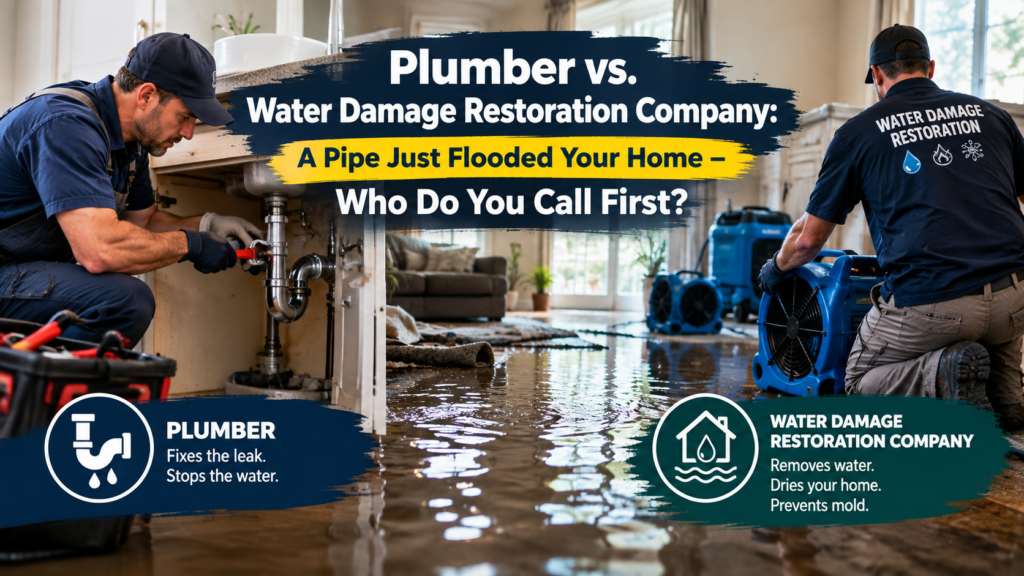
Many homeowners assume that water damage restoration and plumbing are the same job. They’re not they’re two distinct specialties that must work together in a specific sequence. A plumber stops the water. A restoration company removes it and repairs what it ruined. Calling them out of order is like asking a surgeon to close a wound before the bleeding has stopped.
If a restoration crew arrives while your pipe is still actively leaking, they are doing recovery work on a live problem. Water continues spreading while fans run. Moisture maps become inaccurate. Walls get dried on the outside while water keeps saturating them from within. The result? Mold growth inside wall cavities, warped subfloors, and an insurance adjuster who questions why the restoration scope keeps growing.
The Rule of Thumb
Plumber first always. Stop the source before you address the damage. The only exception is a life-safety hazard (fire, electrical danger, or structural collapse), in which case call 911 before anything else.
Step-by-Step: What to Do in the First 60 Minutes
- Shut off the main water supply-Find your main shutoff valve typically near the water meter, in a utility room, or under a sink. Turn it clockwise until it stops. This slows or stops the flood immediately.
- Cut power to affected areas-Water and electricity are lethal together. Go to your breaker box and switch off circuits in the flooded zone. If you’re unsure which breakers to cut, turn off the main breaker and use flashlights.
- Call your licensed plumber-This is your first phone call. A plumber identifies the exact break, repairs or replaces the failed pipe, and confirms the system is watertight before anyone else enters the space to do restoration work.
- Document everything with photos and video-Before anyone touches anything, photograph and video-record every flooded room, every damaged item, and the visible pipe failure. This is essential for your insurance claim and your restoration scope of work.
- Call your homeowner’s insurance-Open a claim as soon as possible. Most policies cover sudden and accidental water damage from burst pipes. Your adjuster may want to visit before demolition begins confirm this before restoration crews start removing materials.
- Call your water damage restoration company-Now and only now is it time to bring in restoration professionals. They will extract standing water, perform moisture mapping, set industrial drying equipment, and scope the structural repairs.
What a Plumber Does (and Doesn’t Do)
Your plumber’s job begins and ends with the plumbing system. They will locate the exact point of failure which is harder than it sounds when a pipe runs through a finished wall isolate and repair or replace the broken section, pressure-test the repaired line to confirm integrity, and advise you on whether nearby pipes show signs of age or stress.
What a plumber will not do is extract standing water, dry out your walls and floors, test for mold, or rebuild damaged drywall and cabinetry. That’s restoration work, and it requires a different license, different equipment, and different expertise.
Watch Out For
Some companies market themselves as full-service plumbing and restoration. Ask specifically whether their restoration division holds an IICRC certification (the industry’s standard for water damage remediation). If they can’t confirm it, the restoration work may not meet insurance requirements or industry best practices.
What a Water Damage Restoration Company Does
Once your plumber has confirmed the water source is stopped and the space is electrically safe, a certified water damage restoration team takes over. Their work is more extensive than most homeowners expect, and it unfolds over days not hours.
Industrial water extraction
Truck-mounted and portable extractors pull standing water from floors, carpets, and crawl spaces far more effectively than any shop vac or consumer pump. In a serious flood event, extractors may run for hours before the space is ready for drying equipment.
Moisture mapping and thermal imaging
This is the step that separates professional restoration from a mop-and-fan DIY attempt. Technicians use thermal cameras and pin/pinless moisture meters to map exactly where water has traveled inside walls, under floors, and above ceilings. Hidden moisture is what causes mold growth 10 days after a flood appears handled.
Controlled structural drying
Industrial air movers and LGR (Low Grain Refrigerant) dehumidifiers run on a precise drying plan typically 3 to 5 days with daily moisture readings to confirm drying progress and adjust equipment placement.
Demolition of unsalvageable materials
Saturated drywall, insulation, and flooring cannot be dried in place. Restoration teams perform controlled demolition often called flood cuts removing only what cannot be saved and preserving what can.
If you’re located outside the Lake Travis area and need a trusted restoration team, the specialists at Akron OH Water Damage provide certified water damage restoration services in the Akron, Ohio region a reliable resource for homeowners navigating post-flood recovery in that area.
Plumber vs. Restoration Company: At a Glance
| Task | Licensed Plumber | Restoration Company |
|---|---|---|
| Find and repair the broken pipe | ✔ Primary job | ✘ Not their scope |
| Extract standing water | ✘ Not their scope | ✔ Primary job |
| Structural drying (fans, dehumidifiers) | ✘ Not their scope | ✔ Primary job |
| Moisture mapping & thermal imaging | ✘ Not their scope | ✔ Primary job |
| Mold prevention / remediation | ✘ Not their scope | ✔ When certified |
| Advise on pipe condition / future risk | ✔ Primary job | ✘ Limited |
| Work with your insurance adjuster | Partial (repair invoice) | ✔ Scope documents, photos, reports |
The Hidden Danger: What Happens If You Skip Professional Restoration
This is where many homeowners make a costly mistake. The floor dries. The walls feel solid after a few days. The shop fans did their job. Everything seems fine until it isn’t.
Water that soaks into wall cavities, under engineered hardwood, or inside insulation does not evaporate on its own timeline. According to the U.S. Environmental Protection Agency, mold can begin growing on wet building materials within 24 to 48 hours. In a Texas summer, where humidity is already elevated, that window narrows further.
By the time mold is visible dark spots on baseboards, a musty smell that won’t leave you’re no longer dealing with a water damage claim. You’re dealing with a mold remediation job that can cost two to three times as much and may require your family to temporarily vacate the home.
Professional restoration’s moisture mapping eliminates this risk. You can see, with measured data, that every affected cavity has reached its drying goal before walls are closed up. That documentation also protects your insurance claim from being questioned later.
Pro Tip:
Ask your restoration company for a final drying report with moisture readings before they remove their equipment. This document is your proof for your insurer and for your own peace of mind that the job was completed to IICRC S500 standard.
When Is It Okay to Call the Restoration Company at the Same Time?
There are scenarios where calling both simultaneously makes sense but only when the plumbing repair can happen immediately and in parallel with extraction. For example, if a plumber is already on-site, has physically stopped the water flow, and is now working on the permanent repair, you can safely call a restoration company to begin extraction. The key is that water must not be actively spreading when restoration work begins in an area.
For large-scale flooding a main line failure, a slab leak that has been running undetected for days, or a supply line failure that reached multiple rooms the coordination of plumber and restoration team often needs to happen simultaneously but in different zones. Your plumber should be the one to clear restoration work to begin in each area as it becomes stable.
Common Causes of Burst Pipes in Lake Travis Homes
Understanding why pipes fail helps you prevent the next emergency. In the Lake Travis area, the most common culprits are:
Sudden temperature drops
Central Texas doesn’t experience sustained freezing, but sudden cold snaps like the 2021 winter storm can freeze exposed pipes in attics, garages, and exterior walls. As ice expands inside a copper or PVC pipe, the pipe wall gives way. Learn more about pipe repair and winterization services we offer throughout the Lake Travis area.
Age and corrosion
Galvanized steel pipes in homes built before 1990 are prone to internal corrosion. As the lining breaks down, pinhole leaks develop and pinhole leaks can quietly soak insulation for months before a full failure makes itself known.
High water pressure
Municipal supply pressure in parts of Texas frequently runs above the 80 PSI threshold recommended by the International Plumbing Code. Over time, chronic high pressure stresses joints, valves, and fittings and the failure usually comes at the weakest point in the system.
Failed washing machine hoses
One of the most underestimated sources of household flooding. Rubber supply hoses on washing machines have a service life of 3 to 5 years. Braided stainless hoses last longer but still require regular inspection. A pinhole failure at the back of a machine can pour hundreds of gallons into a laundry room before it’s discovered.
Dealing With a Pipe Emergency Right Now?
Allstate Plumbing, Heat & Air serves the Lake Travis community with 24/7 emergency plumbing response. We’ll stop the source fast so the restoration team can finish the job right.
Call for Emergency PlumbingSchedule a Non-Emergency Visit
Questions to Ask Any Plumber or Restoration Company Before You Hire
For your plumber:
Are you licensed in Texas? Can you provide a written repair scope before work begins? Do you offer a warranty on parts and labor? Are you available for follow-up if the repair area needs to be re-opened by the restoration crew?
For your restoration company:
Do your technicians hold IICRC Water Damage Restoration Technician (WRT) certification? Do you work directly with insurance adjusters and provide documentation? Can you provide a final drying report with moisture readings? What is your protocol if mold is discovered during demolition?
Red Flags to Avoid
Be cautious of any contractor who asks you to sign an Assignment of Benefits (AOB) form that transfers your insurance rights to them, pressures you to skip the insurance adjuster’s inspection, cannot provide proof of license and insurance, or offers a flat-rate “flood package” without performing a moisture assessment first.
The Takeaway
A flooded home is stressful. The decisions you make in the first hour shape everything that follows your repair costs, your insurance claim, your timeline to normal, and the long-term health of your home.
The sequence is straightforward: shut off the water, shut off power to the area, call your plumber, document everything, call your insurance, then call restoration. Each professional has a defined role. Respecting that sequence is what turns a chaotic emergency into a managed, documented, fully remediated repair.
Allstate Plumbing, Heat & Air is available around the clock for pipe emergencies across the Lake Travis area. We work alongside certified restoration teams and can help coordinate the response so you’re not managing two crews on your own during one of the most stressful events a homeowner can face.
Leave a Reply